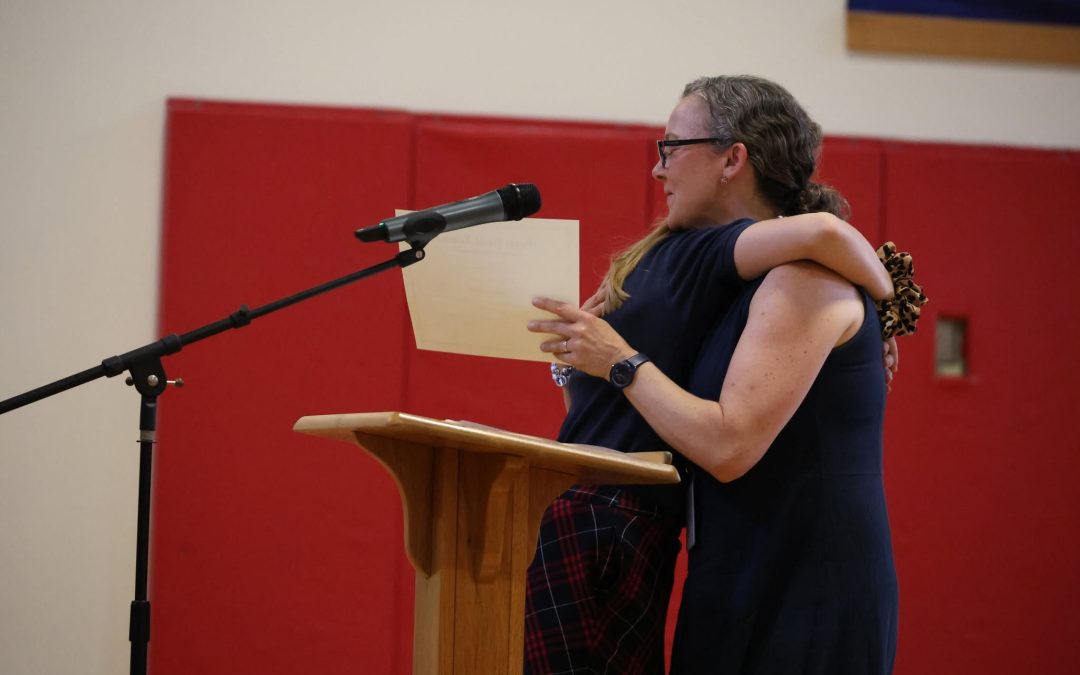
Madeline Gawlick ‘26, Welcome Address
On behalf of the Mount Royal Class of 2026, I’d like to thank you all for coming to our Commencement Ceremony. We are so grateful to have you here as we graduate from this truly formative institution.
We have all grown here, some more than others. And some of us are still waiting for that growth spurt.
Mount Royal Academy is truly unique. Education is about the formation of the whole person, both academically and spiritually. We have not only grown intellectually but also been challenged in sports and public speaking through our recent senior thesis presentations. We have been taught to find our fulfillment in the truth. To seek deeper than surface level. To find something greater. To turn to our faith for answers. We are so incredibly privileged to have received this education.
One unique part of going to such a small school is that we’re all together all day. The Class of 2026 is composed of very different people, yet it works. We might argue like siblings, but we care for each other, too. We have each other’s backs. It’s been a long four years. But it was a fun four years, and I am grateful to have done it with this group of people.
These teachers have been instrumental in forming us as individuals, especially this past year. Thank you to Mr. Bean for the midlife crises at 8 AM in the morning. In all seriousness, thank you. You have first taught us what it means to seek Christ, and then urged us to go out and live our lives well. It is evident that all of our teachers here want the best for us. The advice you have given, both inside and outside of the classroom, will stay with us. It is still surreal to be leaving Mount Royal Academy, but I know that the education and formation that we have received here will be taken with us for the rest of our lives. Thank you.
And now, I would like to invite Mr. Bean, our humanities teacher, to the stage to give the commencement address.
Mr. Ambrose Bean, Commencement Address
Good morning, everyone, and congratulations to the graduating class of 2026. I begin just by saying thank you to these young men and women for asking me to speak today. It is a real honor, and I want you to know I am grateful. I think I do have something to say, and I hope the Holy Spirit can help me to say it well.
Today feels a little bit like the end of a very long family road trip. We have all spent so much time together that there are almost no mysteries left among us. We all know, for example, who you want on your team for class debates and who you might want on the other team. We all know who in the room will be the next to speak—and speak loudly—whenever someone utters a word that even sounds like the name of a Tolkien character. We all know, after the presentations last week, that Warren is… kind of a communist. We know what to expect when Maddie drinks caffeine, when Maria gets restless at the end of the day, when Clayton and Blaise sit directly across from each other in class, or when you shake Addison’s chocolate milk.
Actually, the only real difference between what we have been doing and a very long family road trip is that we did not go anywhere. I have been here for five years, and I feel as though we never got out of the car. The physical environment remained essentially the same. We know every detail of this place: the mysterious stains on the walls in the classroom, the toilet that goes “bump bump bump” in the wall when you flush it, and all the other little quirks and corners of this campus.
The only thing that’s really changed is the people in the car. Some people got in the car halfway through. Some people got out. We lost some dear friends along the way: Matthew Bissah, Taylor Goodspeed, the door handle to the high school. I miss him most of all. It might surprise some of you, but I think Mr. Tremblay knew the whole time. He was truly irreplaceable.
But today, you are all getting out of the car. This leg of the journey really is over, and it is time for you to leave. I know you are relieved by this. You are ready for the change. You are excited, and you should be, because the goal is for you to go and become something better. We are joyful too, because that’s what we all want for you—what I personally want for you. I want you to move on to better stuff. “When I was a child,” says St. Paul, “I spoke like a child, I thought like a child, I reasoned like a child…” As we grow, we move upward. Rung by rung, appetite by appetite, desire by desire. In fact, I would like to propose something countercultural and make the case for it today. Here is something I really believe… if you choose the right things, despite what the world tells you, I promise: life just gets better and better and better.
To understand what I mean, let’s look at the course of a human life in five distinct stages.
First, we all start out by drinking milk. With his amusing and distinctly masculine perspective, St. Augustine observes at the beginning of Confessions that babies are very selfish creatures. All they do is scream to get their way. They have no concept whatsoever that the people around them are tired or struggling. They simply cry out, and the universe answers them. Of course, God designed infancy that way. In the beginning of life, we need others to pour everything into us because we cannot yet stand on our own. Interestingly enough, though, I think that spiritually many people remain at this stage forever. They cling desperately to life. They want their own good, and they care little for anyone else’s. They see the people around them not as ends in themselves, but as means to their own ends. But what is natural in infancy is not meant to last forever. So I guess my first bit of advice is simple and satisfying to say: graduates, as you move into the adult world, please… don’t be babies. Drink something better than milk. Choose the better part.
Second, after milk, we drink juice. I remember this stage of my life so vividly. As a little kid, nothing mattered more to me than chicken nuggets and cartoons and Matchbox cars. I remember stabbing a straw into a Capri Sun pouch and feeling like the richest boy in the world. You could give me one of those as a child and I would be happy for hours. I did not just want to survive comfortably as a baby does. I wanted to play, to laugh, to have fun, to feel excitement, to go new places, to see new things, to explore everything pleasurable and colorful and visibly good in the world. There is something beautiful about the joy of childhood. A boy opening Christmas presents or running outside on the first day of summer possesses a kind of happiness adults often envy. And, indeed, there is a sense in which we should maintain that childlike spirit.
But just as we begin to long for that time and wish we could turn back the clock, like Jay Gatsby at the mantlepiece… the words of Christ pierce our world and challenge us to dig deeper. The crowds follow Him because He multiplied bread, but He tells them, “Do not labor for the food which perishes.” The woman at the well comes seeking ordinary water, and Christ says that He will give her living water. Again and again in the Gospels, Jesus takes ordinary human desires and points beyond them. And interestingly, today, if you offer me a Capri Sun, I will in all likelihood say, “No, thank you.” And this won’t constitute some great act of self-denial on my part. I genuinely don’t want them anymore, along with a lot of other things I used to think I could never live without. The truth is, I want better things now. Some of you graduates are probably imagining how you will use the freedom and independence of the next few years to indulge in every childish impulse you’ve ever had, now with no parents to restrain you. But I’m telling you, as some of you are already wise enough to know, one day you will stab that Capri Sun, and it will no longer satisfy you. You will suck it down, but still thirst.
Please don’t misread my tone. That’s not a melancholic thought! Don’t be too sad when that happens. You are growing up, and I’m telling you, something even better awaits you in the next stage. Graduates, hold fast to your childlike spirit, but drink something better than juice. Choose the better part.
Third: “When I was a child, I spoke like a child, I thought like a child, I reasoned like a child; but when I became a man, I gave up childish ways”… and I started to drink coffee. Americans are—or at least once were—hardworking, creative, industrious people, and America runs on Dunkin. It is the worker’s beverage of choice because it helps him work. He can fend off the pleasure of sleep, which beckons to him throughout the day, and choose to be productive. Parents rely on coffee to serve their children. Teachers rely on coffee to serve their students. Students rely on coffee to annoy their teachers. The market demand is high. Next thing you know, Eddie gets a job at the local Dunkin’ Donuts, and with the infusion of his labor into the system, the whole economy grows, and we are all wealthier. As far as I can tell, that is the American Dream!
The transition into the coffee stage of life is difficult—not only for students, but especially for parents. Because suddenly the child who once needed help with everything begins saying things like, “I think God is calling me to do this.” “I do not want to do that.” “I want to spend time with friends.” “I want to make my own decision.” Parents—and teachers too—have a tendency to imagine that the virtues of these young people are somehow our virtues. Their stories become our stories. Their future becomes our future. We want gratitude, acknowledgment, a return for our efforts. And yet… God has no grandchildren. These young men and women were sons and daughters of God before they were sons and daughters of man.
Parents, here is a hard truth that God is reminding you of today, and I know you feel it. The reality is that your children never really belonged to you in the first place. They are not yours. It was your privilege to be a part of their story, and if you try to cling to them and rewrite the ending as you would have it written—or God forbid, you try to make yourself the central character in that story—then the dynamic shifts, and you no longer feel like the adult in the room. Their precious little lives could only ever have been a gift to you. It would be wrong to force feed them milk and juice now that it is time to let them go. I would encourage you in this stage to ask more questions than you give commands. Listen to them.
And to you graduates: follow God’s voice in your heart, wherever it leads you. Start families of your own. Give yourself to the things you fall in love with. Be grateful for what you have been given, but never let it get in the way of taking the next step. When Christ came knocking, Mary of Bethany did not do what her family expected her to do. Martha was laboring in the kitchen for food which perishes, but Mary chose the better part. Sit with her, and then… drink something better than coffee.
One day, when I was about 25 years old, someone handed me a glass of Bordeaux wine, and I began to understand the fourth stage a little better. I was not a big fan of wine until that evening. I thought it all tasted like grapes. But soon I found myself drinking something that tasted like blackberries and plums, cinnamon, cocoa, and vanilla, French oak and fresh earth. It was complex, delicate, challenging, and delicious.
American industriousness is well and good, but one day, I pray you will wake up and realize that you are less excited about doing things and more excited about being something. In the Old Testament, Solomon is offered riches and a long life, but he chooses something better, and asks for wisdom. Jesus was tempted in the desert to turn stones into bread, but he rebuked the devil with those famous words: “Man does not live on bread alone…” Soon afterward in Cana, he turned water into wine. Graduates, I am telling you. Your palate needs to change. You need to fall in love with virtue. You need to hunger and thirst for righteousness. Like every other commencement speaker in the world today, I can tell you to go out there and become good lawyers and doctors and mechanics and engineers. Yes. And drink enough coffee to do those things well. But I care a great deal more about whether or not you fit that career under the larger calling to be a good man—indeed, to be a saint.
I want you to drink the good wine of courage, temperance, justice, patience, prudence, and honesty. And I don’t want you to drink virtue in some austere spirit of self-denial. I am telling you: these things are actually better. Courage is fiery and bold and flavorful. Patience is smooth and sweet and supremely palatable. Remember, in The Death of Ivan Ilyich, Ivan chooses to play cards with his friends instead of serve his wife and children. And I told you a couple months ago that I pity him! Not because he “won’t get away with it” but because he is missing out. Graduates, believe me. He is missing out on the adventure of a lifetime and a kind of thrilling, noble joy that is a thousand times better than anything that can happen over a card table. All too often, we tend to think that the Church’s moral teachings are something we must tolerate in order to avoid punishment, but in fact the moral life is itself a great reward. In my seventh year of marriage now, I can tell you with the utmost sincerity, there is almost nothing more thrilling than to dive into the mystery of another human person, and run into battle side by side every day.
But I admit… you do need the eyes to see it. If you put Bordeaux wine in my Capri Sun pouch, as a child I would have spat it out in disgust. If you don’t yet see it and taste it, you will just have to trust me, and keep trying it until you do. Like a good sommelier I have to tell you, and risk sounding pretentious, that there is something in the glass you have failed to notice. Do not lose your childlike spirit and your appreciation for the simple things, but choose virtue. Not because you must, but because it really is better.
So what is next? What is the fifth and final stage? Honestly, there is a big part of me that suspects nothing could possibly be better than wine…
And yet… at Cana, the wine in those six stone jars pointed forward to something else, didn’t it?
What was Jesus’ favorite drink? The apostles asked Him if He wanted food, and He replied, “I have food to eat of which you do not know.” What did He mean by that? He met the Samaritan woman at the well, and even though He asks her for a drink, He does not drink any water. Why not? What chalice does Jesus drain when He reaches the end, when He is 33 years old, at the very height of manhood, in the culminating moment of His life and all human history? “Let this cup pass from me,” He says, “nevertheless, not as I will, but as Thou wilt.” What was in that cup? And a few short hours later, suspended naked on the Cross for all the world to see, bleeding and dying, He utters words that turn everything we think we know upside down: “I thirst.” So they put a sponge full of vinegar on hyssop and held it to His mouth. When Jesus had received the vinegar, He said, “It is finished”; and He bowed His head and gave up His spirit.
The world assumes happiness means maximizing comfort and minimizing sacrifice. But Christ reveals that the highest joy is found not in filling ourselves up, but in pouring ourselves out. He came not to be served, but to serve. Do you remember, graduates, when we read together the dizzying end of Dante’s Inferno? How he passes the central point of the whole world at the moment of Christ’s death, and he feels that world, and his place within it, flip on its head, as he crawls out of hell a little before dawn on Easter Sunday? The more I look at the startling and mysterious lives of the saints, the more I wonder whether the saints are not the only people standing right side up in a world that has inverted everything. I look at St. Peter, crucified upside down, and I wonder if perhaps he was the only one oriented correctly, and the rest of us have it wrong. After all, Christianity has always insisted upon the paradoxical truth that the way upward is downward, the way to life is death, the way to glory is sacrifice.
So yes, the fifth and final cup, and the cup that Jesus drank, is the cup of vinegar and suffering. It is tempting to flee this cup, paint over it, or pretend it isn’t there. But in light of the Gospel message, a Christian, with his eyes fixed on heaven, is capable of taking this cup, rejoicing in it, and saying, “What else you got? Compel me to walk a mile? I’ll go two. Strike me on the cheek? Here is the other one!” Why? Because we know that the battle is already won. “Alleluia!” we say to death. “Nice try. You’ve lost. The tomb is empty. Christ has destroyed you. Your little empire has crumbled. Thank you for the crown.”
Graduates, I am not telling you that this is easy; I am telling you that it is better. It is invigorating! The blood of Christ is the headiest wine ever poured, and those who drink of it become capable of terrifying and beautiful things. Saints abandon wealth. Missionaries cross oceans. Martyrs walk singing into death. Religious sisters veil themselves from the fashions of the world and proclaim with their very lives a thirst for something beyond. Graduates, I tell you, from one human being to another, there is something delicious in sacrifice.
What is on the other side?
Consider the beautiful words of C.S. Lewis, as he talks about heaven: “The books or the music in which we thought [Beauty] was located will betray us if we trust to them; it was not in them, it only came through them, and what came through them was longing. These things are good images of what we really desire; but if they are mistaken for the thing itself they turn into dumb idols, breaking the hearts of their worshipers. For they are not the thing itself; they are only the scent of a flower we have not found, the echo of a tune we have not heard, news from a country we have never yet visited. … It would seem that Our Lord finds our desires not too strong, but too weak.”
I would ask you all to consider if anything could be more hopeful or give us more cause for joy! Jesus Christ is risen from the dead, and he dies no more! Now we know that every sacrifice on earth wins a great reward in heaven—a reward so good, that if you could see it now, you would beg to suffer more in this life. “Do not lay up for yourselves treasures on earth,” says Jesus, “where moth and rust consume and where thieves break in and steal, but lay up for yourselves treasures in heaven, where neither moth nor rust consumes and where thieves do not break in and steal.” We have been invited to pick up our cross and follow the risen Christ to heaven. That’s where the good stuff is.
And that’s where I want to end this speech.
Graduates, you think this life is good, and you are right! But I’m telling you. That life is better. Better than pleasure. Better than wealth. Better than fame. Better than earthly security and comfort. Better. Simply better. Sweeter. Richer. Ineffable. Choose it.
Drink something better than wine. Become like little children again, this time for the Kingdom of Heaven.
Mrs. Lisa Sweet, Introduction of Student Address
This morning, we have the privilege of hearing from a student whose high school journey has been marked by truly remarkable growth and steady maturity. Most impressive, she has emerged as a leader with a leadership style all her own. She’s spunky in the best way—fearless in speaking up, unafraid to stand out, and always ready to advocate not just for herself, but for her entire class, and most especially for her brother, Anthony. She has marched into my office more than once this year with concerns about such and such with Anthony, wondering what I plan to do about it. Don’t worry, Maria, we will take good care of him when you are gone.
Maria is also spunky in a bit of a fierce way. I have seen her body check Will Kalpakgian into the wall as they were walking down the hallway. I’m not sure what Will did to deserve that, but Maria sent her message.
Honestly, it has been a delight to see Maria’s evolution over the years into the strong, confident, beautiful young woman she has become. Please join me in welcoming our student speaker, Maria Fraioli.
Maria Fraioli ‘26, Student Address
Good Morning.
On behalf of the Class of 2026, I would first like to thank parents, teachers, and benefactors for attending today. I would also like to thank everyone who has helped us along the way with starting our journey towards finding who God wants us to be. This journey has been challenging, as each of us are very different individuals. Despite our differences, having a good sense of humor and a respect for one another has helped build our relationships.
I started attending Mount Royal in fourth grade. Transferring from a public school to a private school was challenging. I realized that I actually had to do my work in order to get good grades. I soon became aware that the education in public school was not as beneficial and fulfilling as the one I was getting from Mount Royal.
Looking back on the years past, our journey together as a class has been crazy. We’ve always been more of a rowdy class. So to all the teachers who had to put up with us over the years Thank You. But honestly, I think our ability to always keep things light and have fun is what helped us get through the high school struggles. This class has always been one to joke around and not take things too seriously. In the end I think it all came together. We got closer this year than any other. I’m thankful to have each and every one of you in my life. I have learned and grown from these relationships. So underclassmen something to take from us would be to remember to have fun and take your time because four years of high school go by quickly.
During my time at Mount Royal, I have learned that in order to truly grow and gain knowledge it is important to have the ability to work hard and think on your own. True growth and knowledge requires hard work. I am proud to say that the teachers do truly care to educate the whole person, one student at a time. Each teacher strives to help every student see what is good and true. Attending a small school has been rewarding because we have the ability to form relationships with the teachers. We have more opportunities to directly go to our teachers for any questions.
One moment that has always stuck with me was when Mr. Bean told us that as we move forward with our lives we need to know that our plans are not always going to work out. Ultimately he was reminding us that we should be open to change so we may see what God has in store for us. It is important to remember that we need to follow and trust Christ as we are making our decisions. At the same time, we can have goals and dreams that we are moving towards but know that God may change something and open a door to something new.
As we move into the next chapter of our lives, it’s important that we remember that it is okay to not have everything figured out. This new chapter truly reminds me of starting freshman year. Freshman year is the first step to trying to figure out who you want to be. From how we were taught by our parents and this school, we can take what we have learned and apply it to our lives.
Mount Royal has done a great job with instilling within us the ability to strive for good. Through seeking the good, truth is revealed to us, keeping us on the path that God has intended for us. So thank you to everyone who has played a part in helping each of us develop into the person we are today and God bless.
Mrs. Lisa Sweet, Introduction of Student Address
Our next speaker is the rare student who takes responsibility voluntarily — which already makes him a statistical miracle. However, if you consider the struggles, both academic and just “life”, that he has had to overcome, it is clear that his transformation is truly miraculous. During his junior year, Edward took charge of organizing the K of C squires for flag duty. On his own initiative he recruited, trained, and supervised the boys who raised and lowered the flag each day. It was important to him, so he got it done.
Faith is also important to Edward, and he (again of his own volition) became the school sacristan. He showed up early to set up for Mass on Fridays, and stayed to break down, as well. Again, it was important to him, so he got it done.
It was revealing at the senior dinner on Thursday how much Eddie has grown in confidence, as he was basically directing the show from his seat at his table. Even his guardian, Terry, turned to me and said, “My goodness, he is running things!” as Eddie called out the people he wanted to get up to speak about the class.
It is incredibly rewarding to have watched him become a confident, thoughtful, young man of purpose.
Please join me in welcoming Eddie Kanu to the podium.
Edward Kanu ‘26, Student Address
Hey everyone, and welcome to Mount Royal Academy’s 2026 commencement. For everyone who doesn’t know me I’m Edward Kanu and here I am .
To reiterate what Maria just said I would also like to say…
On the behalf of the Class of 2026, we would like to thank the faculty and staff of Mount Royal for everything they have done for us throughout the years. Your sacrifice and patience and dedication to us have shaped all of us in ways we may not have realized yet. In a special way we would like to thank Fr. Michael Sartori for his spiritual guidance and constant support for our school and my class.
Also I’d like to thank our benefactors without their generosity and support this school would not honestly be here today. To Mr.Tremblay for your leadership, and Mrs. Sweet for her kindness and to Mr. Bean for giving our address and ever wheeling patience, God only knows how much that was tested over the years.
And above all else I’d like to thank God. Looking back on my years here, I can truly say that He guided this school and everyone in it.
But today is more than just a graduation, it’s a moment we look back on who we were when we first came here and realize how much we have changed since then. A lot of us had spent many of our lives here, me in practicality, growing up here together, learning.
What makes our school so special isn’t the academics or sports.. Definitely not the sports, but the community and the faith that connects us all. From a young age we’re taught not only to succeed in school, but to also live out our lives in faith, kindness and respect to others. We learned from our teachers, our classmates, and the examples of older students who once guided us.
And before we even realized it, we were those older students ourselves.
Mount Royal’s mission “is to educate the whole person one student at a time” and after my many years here I can say without a doubt I have seen that mission lived out everyday.
Now, as my fellow graduates of the Class of 2026 we are entering into a new chapter into our lives. Most seem to be going off in different directions….Well actually not most. We leave here with the same purpose, to live in the light of Christ and bring that light to others.
Just as how Christ sent the apostles to make disciples of men of all nations, my fellow graduates we are called to do the same, to courageously bring the light of Christ to all, that is our purpose.
Fellow graduates, wherever life takes us, don’t lose faith in the values that brought us here today. The success, achievements, and accomplishments that we meant yet earn one day won’t last forever but Christ does, in Christ we can find our certainty, in Him we can put our faith.
Everything we learned here at Mount Royal was meant to prepare us not only for the future, but to make a difference in the lives of others one person at a time.
Thank you all, and God bless.
Mrs. Paulina Bean, St. Joseph Award
Like St. Joseph, this student has great reverence for all that is good and holy and has a profound and personal love for Jesus and Mary. She sees and loves Jesus in the people around her, and she truly hungers and thirsts for righteousness. I can personally attest to this students’ deep prayer life and her desire to always follow God’s will, even into places of danger and uncertainty. As president of the Knights for Life Club, she has passionately led her friends in standing up for the dignity of each human person, planning numerous trips to pray outside of abortion clinics, coordinating apologetics trainings on campus for schoolmates, and attending fundraisers sponsored by pro life groups in our local community. As vice president of the National Honor Society, she has also led service projects caring for the homeless and has planned meaningful events for our school community. With a saintly level of courage, strength, humility, and compassion, this student advocates for those who need help and is truly present with her friends in their sufferings and their joys. She does not do these things for recognition or because she has to, but always out of love. I am personally extremely proud to call this young woman my student and friend. She inspires me and everyone who has the blessing of knowing her. Please join me in celebrating the recipient of the St. Joseph Award, Leah LaMothe.
Mr. Derek Tremblay, St. Joseph Award
When teachers make their nominations for the St. Joseph award, this is the criteria:
We look to the litany of St. Joseph to describe this student: faithful, just, patient, service-oriented, selfless, prudent, obedient, diligent, hard-working. This student refrains from gossip, shows compassion to his/her peers, listens to his/her teachers, and values their faith above all. Regardless of grades, this student gives their best effort.
On behalf of Mr. McMenaman, it is my pleasure to present the second St. Joseph award. Mr. McMenaman wrote the following about Eddie Kanu:
“While it has been a recently developing tradition for a senior emcee to assist in the set up for Mass on Fridays, Eddie decided to set the bar even higher for future years. Without prompting, Eddie showed up right from the start. Quietly and cheerfully, he prepared the altar. Then, forbearing against hunger, Eddie remained after Mass and helped put everything away. I can’t recall a finer example of the qualities of St. Joseph and I am deeply grateful for his service.”
My extended comment about Eddie is this: I vividly remember when his father asked me what to do with his children after he would eventually succumb to cancer. I felt entirely overwhelmed by that question and wondered why he thought it wise to ask me what to do. My answer was Bob and Terry but they had already made efforts on their end to provide for Susan and Eddie somehow in their retirement. I think this entire community owes Bob and Terry a standing ovation. The way they have loved Susan and Eddie in such an obscure manner is almost a shame. It is shameful because so few of us may know what they did for them. It is a story that the world needs to hear. It is the same thing St. Joseph would have done, and that is partly why Eddie is winning this award. Eddie, come get what you earned, and let us shower Bob and Terry with what they deserve too!
Mr. Derek Tremblay, Semper Altius Award
When teachers make their nominations for the Semper Altius (‘always or ever higher’) award given to a graduating senior, this is the criteria:
This award is given to one graduating student who has been the model of a Mount Royal Academy student over the years attending the high school. This student has modeled the life of Our Lady, Mary, in humility and love of God. This student has been a person of virtue in his or her studies and in his or her personal life.
Beauty does not exist solely in the eyes of the beholder. Beauty is a magnetic force that manifests in many forms. When something beautiful is encountered, it is undeniably attractive to the human eye. The eye alone does not perceive beauty either. The deepest, most serene and lovely form of beauty is seen by the soul. I would argue that the most beautiful creation of God is a beautiful soul. Such beauty is magnanimous in nature: forgiving, selfless, noble, and grandiose in the capacity for love. Because of its grandeur, the beautiful and therefore magnanimous soul is intrinsically inviting towards others in an effortless and sublime way.
This lovely lady has a beautiful soul. There is a depth to her that she prudently reserves for the One she loves the most, which is our Lord. And she puts her beauty into action in what I will brazenly refer to as militant. She fights for her love for the Lord, and refuses to let any external circumstance or suffering derail her from Him. She said this herself to end her Senior Thesis presentation: “Our vocation is not the path that leads us to loving God, loving God is the path to finding our vocation.” Despite that penetrating insight, Isabelle is a normal woman. She could probably beat Maria in a four wheeler race – sorry Maria – and she is a graceful dancer. She loves the natural order with even greater intensity – perhaps too much baking in the kitchen – yet this ferocity is ordered by the virtues of charity and humility. It is a stunning combination of virtues that surprises and inspires all of us: she is ferocious yet modest; she is prayerful yet active; she is confident yet humble. In short, the paradigm she embodies is the highest expression of a human being fully alive! Every time she approaches me I honestly feel unworthy because of her level of holiness. I ask the Holy Spirit to ensure that I level up to her dignity. The beauty of her witness will never depart this campus because all of us are forever changed by the way she loves Jesus. May all of us love our Lord as much as Isabelle!
Mr. Derek Tremblay, Closing Remarks
On Wednesday Father Michael provided us with the standard wisdom from the Office of Readings at the high school retreat. Thank you Father for always anchoring us in what Holy Mother Church offers for guidance from the liturgy of the hours.
There were two questions from Saint Augustine’s Confessions in that particular reading that I would like to pose before you make your final departure.
- “Where did I find you, that I came to know you?”
- “Is not the life of man upon earth a trial, a continuous trial?”
In other words…
- How did I discover you Lord?
- Is my life meant to be this hard?
When I think of you as a class, I want you to know what I learned from you. The defining virtue of the Class of 2026 is perseverance. Steadfastness.
None of you had it easy to get here: too many of you have dealt with the death of a parent. Some of you relocated from other areas in the country. Most of you started new schools in your educational journey, including this one. Again, some of you may not have a relationship with your mother or father. I know some of you have older siblings and how hard it is to meet their mold. Some of you have seen and experienced some really traumatic things. Some of you have even committed some really bad sins.
So have I. So have we.
I and we are just so proud of you.
I and we are just so grateful for you.
- How did I discover you Lord?
- Is my life meant to be this hard?
You must ask those questions almost every day. Ask the Lord. Do not be bashful. He will answer you. May I tell you how he answered me?
I got this guy here. His name is Benedict Paul. Look at him. Who could deny his awesomeness?
This little guy is not a material object for my joy. He is a reminder of the sheer gratuitousness of our existence.
Should I be upset because God failed to consult me before He made me?
Or can I be willing to see what He does for me even when I am not paying attention? Can I put down what I think is best because He can do it better?
My worthiness comes from God alone because there is no way I am worthy on my own. There is also no human institution that makes me worthy or grants me dignity. That comes from God which gives me great optimism because it can never be fully removed or diminished. The math of God is infinite, which makes me destined for the same timeline. That is quite an oxymoron that I just said!
Faith is a gift, it is your greatest gift. You all have it at some level.
When I answer those questions, this is what I come up with:
- My faith is a gift. God gave it to me.
- I am not on trial, but I am trying to be a better lover of God and everyone he loves.
So how do we actually live together in communion given these unsettling questions from Saint Augustine?
First, a word of caution. Anything impersonal detracts from our humanity. Personal only happens in person. There is no other way to be in relation to others that fully activates the way we are made to love. Every other option still misses the mark and limits authentic, meaningful interpersonal fulfillment.
Second, a word of encouragement. Be steadfast in faith. Your closest confidants must share the same starting point. If it is not faith, do not settle. Strive to surround yourself with faith because your fulfillment is on the line. In other words, only marry someone who actually believes what you believe!
Live as persons – embodied souls – and joyful communion is possible.
It would be inappropriate for me to fail to cite an authority from our tradition before sending you on your vocational path of loving God first, then finding who you are meant to be. Father Paul Scalia is the son of the late Supreme Court Justice Antonin Scalia, a devout Catholic and civil servant. Although not traditional in a sense because perhaps not enough time has passed and he is contemporaneous with us, I think his contributions to the intellectual heritage of Christendom will buttress his father’s efforts to preserve human dignity and the common good. He recently wrote these words in this pentecostal season:
In short, to receive the Spirit, something within must give. We typically want to shoehorn God into our lives, to make Him work for us. But the Spirit does not fit into our worldly lives. He’s not, if you will, designed for that. Rather, like a driving wind that brings in fresh air but also sometimes upends things, He dislocates aspects of our lives so that there is more room for Him to work.
Point is, there is nothing convenient or comfortable – in the world’s sense – about the Spirit. He comes, not to continue our lives as they are, but to live within us and to reproduce the life of Christ within us. That requires change on our part. Indeed, even the comfort He brings is beyond the world’s understanding, doesn’t fit the world’s estimating of comfort. Life according to the Spirit requires the unconditional willingness to change.
Our Lord tells us that the Father “does not ration his gift of the Spirit.” (John 3:34) Indeed, He is not stingy. But we are. We place the barriers and obstacles to the increase of His love within us. Or we want His gifts of grace for our pet projects, not for growth in Him.
For this feast and this gift of the Spirit to be effective, we must allow Him to burn and dislocate us. To purify our hearts with His fire of love and to move them to where He needs them to be.
Your hearts are ready to be moved. I must say I love all of your hearts. We all see them and we know you are ready to set the world ablaze!